

There are days when I don’t really think, I just reach. The same jeans. The same coat. Sometimes the same outfit I wore the day before. It’s not a style statement. It’s a feeling.
Over time, I started noticing that these choices showed up most when I was overwhelmed, tired, or emotionally processing something I didn’t yet have words for. And that’s when it clicked: my default outfit wasn’t about fashion at all. It was about my nervous system.
We all have one.
The outfit we reach for when we don’t want to think. The jeans that feel like home. The oversized hoodie. The all‑black uniform. The matching set that somehow makes life feel more contained.
Your default outfit isn’t just about convenience or laziness. It’s often a quiet reflection of how safe your body feels and what it’s trying to regulate.
The Nervous System, Briefly (and Gently)
Your nervous system is constantly scanning for safety or threat. When you feel calm and regulated, your body has the capacity for play, creativity and expression. When you’re stressed, overwhelmed or emotionally activated, your system shifts into protection mode.
Psychologist Stephen Porges’ Polyvagal Theory explains how our bodies move between states of safety, mobilisation and shutdown, often without conscious awareness. Clothing can become part of how we signal safety back to ourselves.
What you wear can soothe, shield, ground, energise or help you disappear.
The Comfort-First Default: “I Need to Feel Safe”
Think: oversized knits, hoodies, leggings, soft fabrics, loose silhouettes.
This often shows up when the nervous system is seeking containment. Soft textures and roomy shapes reduce sensory load and offer a sense of being held. Research on sensory processing shows that physical comfort can directly reduce stress responses.
You might notice this default during periods of emotional processing, burnout, heartbreak or big life transitions.
If this is your go-to, a small experiment could be adding one intentional element: jewellery, a structured bag, a favourite scent, not to change the outfit, but to gently reintroduce agency.
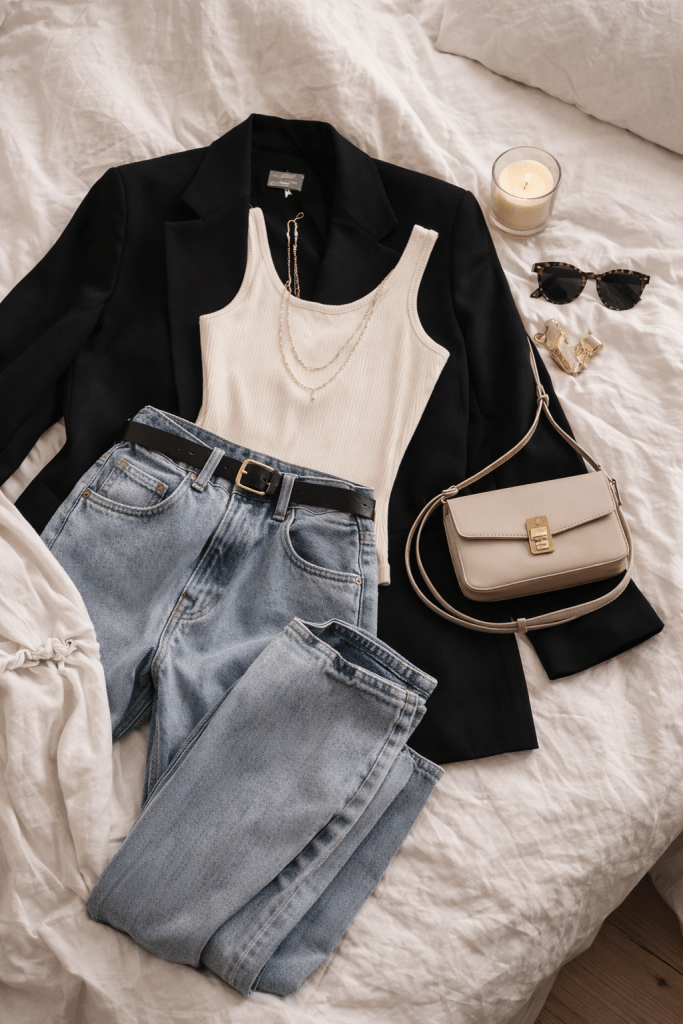
The Uniform Dresser: “I Need Predictability”
Same colours. Same silhouettes. Minimal variation.
This often reflects a nervous system that values control and efficiency. Decision fatigue is real, and having a uniform reduces cognitive load. Studies on decision‑making show that fewer daily choices can help preserve mental energy.
Uniform dressing can be deeply regulating, especially during busy or mentally demanding periods. The risk isn’t the uniform itself, but when it becomes avoidance: a way of staying invisible or emotionally muted.
Check in with yourself: does this outfit help me show up, or hide?
The All-Black Default: “I Need Protection”
Black is grounding, absorbing and boundary‑creating. Many people instinctively reach for it during times of vulnerability.
From a nervous system perspective, black can function like armour, emotionally containing, visually simplifying, and reducing exposure. It’s not surprising that black often dominates wardrobes during grief, uncertainty or periods of low emotional safety.
If black is your constant, you don’t need to abandon it. You might instead play with texture (silk, leather, knit) or subtle contrast to invite expression without sacrificing safety.
The Put-Together Default: “I Need to Stay Regulated Through Control”
Matching sets, tailored pieces, styled hair, even on low‑energy days.
This can signal a nervous system that regulates through structure and performance. Looking composed helps you feel composed. There’s a sense of emotional containment in appearing ‘together’ when things feel messy internally.
There’s strength here, but also a question worth asking: do I allow myself softness when I need it?
Sometimes swapping one structured element for something softer can be surprisingly regulating.
The Expressive Default: “I Feel Safe Enough to Play”
Colour, accessories, experimentation, joy.
This often shows up when the nervous system is relatively regulated, when there’s enough internal safety to explore identity and be seen. I’ve noticed that on days I feel emotionally settled, I dress with far less hesitation, I reach for colour or something playful without overthinking it.
Research on enclothed cognition supports this idea, suggesting that what we wear doesn’t just reflect how we feel, but can actively shape confidence, mood and focus.
If this used to be you and isn’t anymore, that’s not a failure. It’s information. Expression usually returns after safety, not before.
Dressing as Nervous System Care
Your default outfit isn’t something to fix. It’s something to listen to.
Instead of asking, “Does this look good?” try:
- What does my body need today?
- Am I dressing for safety, control, invisibility, or expression?
- What would feel regulating and not impressive?
Fashion doesn’t just reflect who we are. It can gently support who we’re becoming.
Sometimes the most healing outfit is the one that meets your nervous system exactly where it is.
References & Further Reading
- Porges, S. (2011). The Polyvagal Theory: Neurophysiological Foundations of Emotions, Attachment, Communication, and Self‑Regulation.
- van der Kolk, B. (2014). The Body Keeps the Score.
- Adam, H., & Galinsky, A. D. (2012). Enclothed cognition. Journal of Experimental Social Psychology.
- Kwon, Y. H. (1998). Body image, self‑concept, and clothing behavior. Clothing and Textiles Research Journal.
 mindandfashion.com